
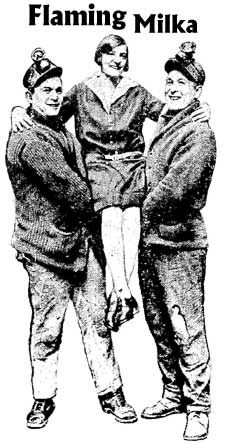
"Flaming Milka," Colorado's rebel girl wore bright red clothing, engaged in physical confrontations with men, and led hundreds of toughened miners in protests against murderous conditions in the coal fields.
Photo credit Industrial Solidarity,
provided by Joanna Sampson
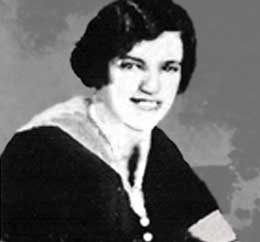
This wasn't just any fight: Colorado was experiencing industrial feudalism. Working people were dying by the hundreds and coal barons enforced their demands with machine guns and bayonets.
Amelia "Flaming Milka" Sablich was nearly forgotten by history. But her story of courage and self-sacrifice is being told once again.
Milka was born in Colorado. Her father brought the family to the United States in 1907, a year before she was born. He was a coal miner.
Milka and her older sister Santa saw injustice, and they joined the fight to set things right.
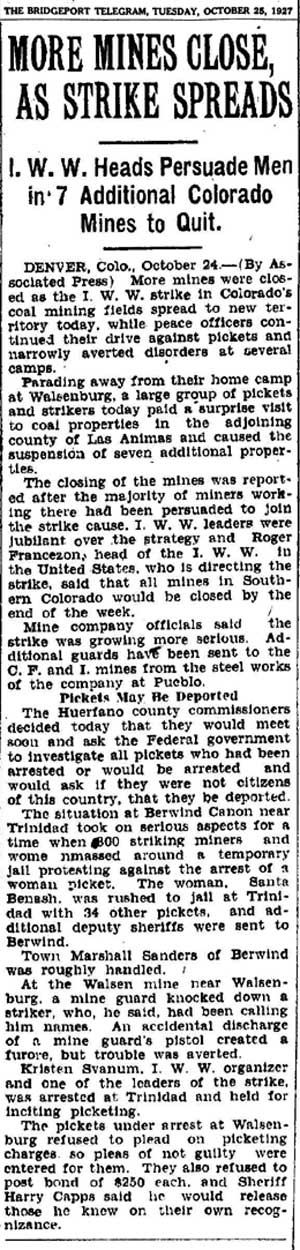
When the organizers of the 1927 strike were imprisoned on charges of vagrancy or illegal picketing, Milka and other women courageously stepped up to the challenge, becoming the new strike leaders.
Because of her courage, her charisma and her determination, Milka achieved national attention.
Milka was nineteen years old.
___________________________
The Minnesota newspaper article below doesn't hint at the turbulence that convulsed Colorado in 1927. But it provides a glimpse of Milka's motivations and her character.
___________________________
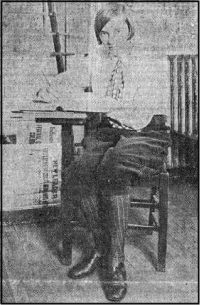
"Flaming" Milka at a school in Duluth,
Minnesota, February 22, 1928.
___________________________
Newspaper clipping with photo
from the Duluth News-Tribune,
courtesy of Duluth Public Library
___________________________
February 22, 1928
'Flaming' Milka, Girl Strike Leader, Enters Duluth School
Champion of Colorado Miners to Prepare Herself for Further Campaign on Platform.
Early last November, when coal miners of Colorado started their strike for better working conditions and higher wages, a 19-year-old girl leaped into national prominence through her sensational activities in connection with the strike. With the fervor of a Joan Of Arc, with fiery speeches, and with spirited clashes of a hand-to-hand type with police guards, "Flaming" Milka Sablich helped organize the miners, started the forming of picket lines, and became herself a leader of the strike.
This same girl, her cause won since the Colorado miners have gone back to work under a satisfactory agreement, is, for the time being, a permanent guest in Duluth. Monday morning she started studies at the Work People's college in Smithville where she will remain until that institution closes in April. And until that time, Milka plans to forget in the absorbing task of learning, the interests of the laboring groups to which she intends to devote her life.
Impetuous Spirit.
Newspaper men gave Milka the sobriquet of "Flaming." A red flannel dress, worn when she made her first public denunciation of the mine operators, furnished the inspiration. But only in part. A surging, impetuous spirit which brooked no opposition and which led her to organize the women of the mining district into an efficient fighting unit, was the real cause for the title which she has carried ever since.
Milka's school education ended at the eighth grade. But her experience in real life has been varied to the extreme. The daughter of Croatian parents, she has worked at all trades—has waited tables, worked in a laundry, packed butter in a dairy. When the strike started, she made a visit to the mines, saw conditions as they existed, and left her work to take up a bigger job—that of helping the miners.
Her first experience was a fight with mounted police guards which sent her to the hospital for a while to recover from bruises. Nothing daunted, she started picket lines and was thrown into jail for three days. But jail was only a needed rest, and her subsequent activities put her behind the bars for five weeks. "A good rest," was the way she described it.
Sent on Speaking Tour.
After that it was unsafe for "Flaming Milka" to remain at Trinidad, Col. So she was sent on a speaking tour of the United States, making stops at all principal cities and a group of smaller towns and villages. Her brown eyes flashing fire as she told of the work boys and girls were doing in the Colorado mining regions, Milka mounted platform after platform to ask for aid to the miners. No salary—just bare expenses—but that was sufficient. To fight for a cause in which she believes—the interests of the laboring classes—is sufficient compensation for the youthful champion of the miners.
Outwardly, Milka is quiet and retiring. Slender, with brown bobbed hair and eyes the same hue, she gives no impression of being a strike leader. Only when her low-pitched voice becomes animated with undisguised indignation does one understand the spirit that slumbers behind her calm demeanor.
The police guards who fought with her and who harassed the picket lines, Milka calls "pool hall bums," and there is bitter hatred in her voice when she refers to them. And the armed men who came out in the employ of the mine operators, she mentions in equal anger.
What does Milka intend to do with her life? As far as she is concerned, there is only one vocation worth while. And that is a life devoted to bettering conditions of the laboring classes. At the Workers' college she is studying public speaking, labor problems, and political economics. And when the right time comes, she intends to once more agitate in defense of the rights of her people.
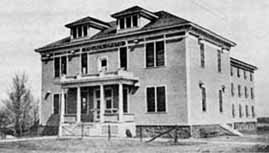
Minnesota's Work People's College, owned and operated by the Industrial Workers of the World
Milka's enrollment in the Workers' college is not by accident. Last Sunday she came to Duluth to speak at the Woodman hall at a mass meeting for relief of the striking miners. Students at the Workers' college went to hear her, and decided to pay, by individual contributions, the expense of having her stay in Duluth and attend the school. And the youthful champion of labor interests likes Duluth. So much so that she plans on coming back next year to study in preparation for her career as she has planned it.
___________________________
This was a period of robber barons and raw corporate power. Colorado industry was controlled by men like John D. Rockefeller and Jesse Welborn. Companies imported workers from around the world, often treated them worse than mules, and then brutally suppressed their strikes. Some Colorado newspapers openly called for violence to discipline the strikers.
Newspapers that opposed the strike weren't pleased with the valorous nickname "Flaming Milka" given by reporters to a young woman as she addressed the strikers. The Denver Morning Post christened her "Flamin' Mamie" after the lyrics of a popular 1925 hit. The words perversely suggested her role in the 1927 coal strike:
Her father's name was Burns,
He worked in a mine,
'Said she ate a box of matches
At the age of nine.She's the hottest thing...
Since the Chicago fire.
The expression "Flamin' Mamie" represents a stereotype; it has come to symbolize a fast living, free spending female with no loyalty except to her own scandalous lifestyle. Applied to a brave young woman risking life and limb in a desperate strike by impoverished coal miners, the popular connotation is not a good fit. The miners struggled to eke out a meager existence from dangerous work, and the only extravagance within sight was that of the coal company owners. The pro-company newspapers may have used the "demanding vamp" moniker hoping that it would further discredit the strike.
If the intent was to dismiss Milka, then tagging her with the nickname of a temptress failed. Amelia Milka Sablich caught the attention of reporters wherever she went during the Colorado strike, often inviting at least some sympathetic press coverage, even in papers that were hostile. And no one showed more determination or integrity than Milka (and the other women on the strike line) when it came to fighting for the cause.
To the Denver Morning Post she may have been Flamin' Mamie, but to the families of the strikers she will always be Milka, a heroine of the 1927 strike.
Flamin' Mamie, the sure fire vamp,
The hottest baby in town,
She's a hard scorcher,
Loves torture,
A gal that just burns 'em down.
___________________________
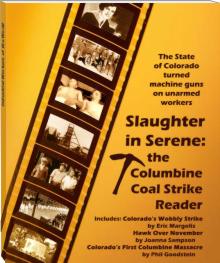
Milka is not the only fascinating story from the 1927 strike. Here is an article with more about Milka, the strike, and some details of a new book that will open your eyes!
Or, check out these articles about Milka and her role in the strike. Use scroll bars if necessary, and BACK button to return.
October 25, 1927, Milka's older sister Santa Benash is arrested
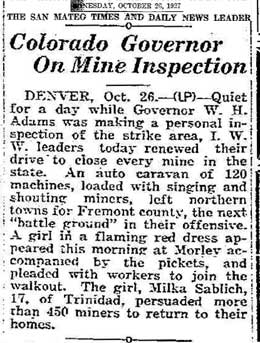
October 26, Milka talks strike, 450 miners walk out of mines
October 27, Milka leads strikers to close Delagua mine
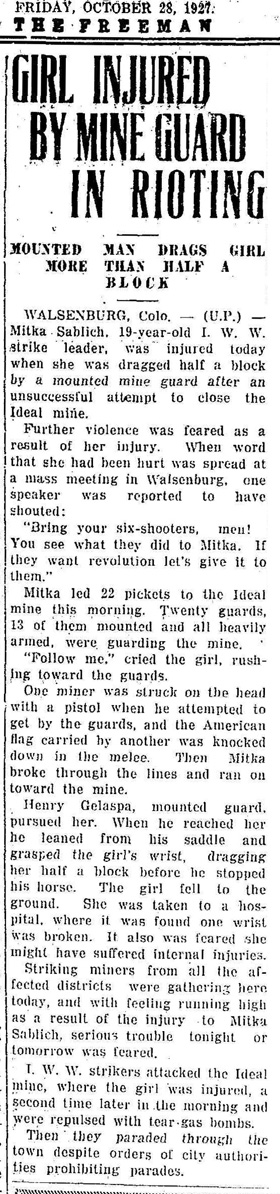
October 28, Milka is dragged, injured by a horseman
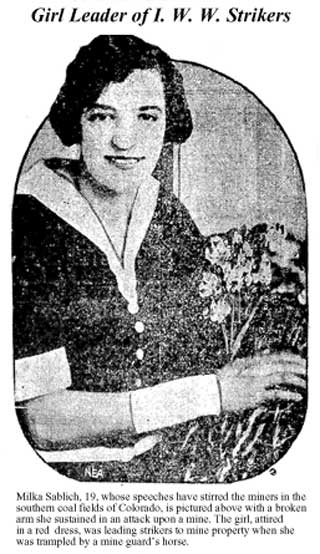
Photo of Milka with cast after injury
Milka tours the country to organize support for the miners
Read below for information on the delightful 1925 hit "Flamin' Mamie."

There were many versions of Flamin' Mamie, performed by jazz artists and orchestras. The song has also been described as early rockabilly. Aileen Stanley delighted audiences with her version in 1925, with brilliant support from Billy "Uke" Carpenter on the ukulele. The 1925 hit may be downloaded here:
http://www.nalu-music.com/nalu/flamin_mamie.mp3
From: http://www.nalu-music.com
Vampires come,
Vampires go,
But a certain vamp I know
Goes on forever,
I wanna tell the world she's clever.
And everything this baby's got,
Has to be flamin' hot
'Cause if you pass her on the street,
Here's what you'll repeat:
She's Flamin' Mamie, the sure fire vamp,
The hottest baby in town,
She's a heart scorcher,
Loves torture,
Until it burns 'em down.
Of all those damper turnin' mamas,
Not one compares,
'Cause it stands endurance,
Carries fire insurance
On everything she wears.
When it comes to lovin',
She's a human oven,
But she's hard to understand.
You know it may sound funny
But paper money
Burns right in her hands.
A firemen that's so old,
He had to retire
Said she's the hottest thing he's seen
Since the Chicago fire.
Flamin' Mamie,
Sure fire vamp,
The hottest baby in town. [Repeat verse]
She's a door checkin', home wreckin',
Gal that burns 'em down.
Come on you futuristic papas,
It's time you're told.
She's got 'em all cheated,
She's a pre-heated
Gal that's anything but cold.
Her nerves are pensive
But her mind's expensive
And she knows her P's and Q's.
She's a red hot stepper,
Sprinkles cayenne pepper
In her dancin' shoes.
Now her father's name was Burns,
He worked in a mine,
'Said she ate a box of matches
At the age of nine.
Flamin' Mamie,
Sure fire vamp,
Hottest baby in town.
As far as i know, the song was the first use of the term "Flamin' Mamie," and it appears that the song was composed in 1925. Since then it has been used as the name for plays, a movie, race horses, World War II bombers, azaleas, night clubs, flaming cherry sundaes, and probably a few other things that i missed.
Flamin' Mamie was composed by Fred Rose and Paul Whiteman. Whiteman was born in Denver. He has been described as the most popular band leader of the 1920's.
Flaming Milka,
IWW rebel girl